

Quick Answer: Patio cover colors come from three charts: the frame (posts, beams and lattice), the solid flat pan ceiling and the insulated roof panel ceiling. Light colors like White, Cameo and Almond reflect more sun and keep the patio brighter; Spanish Brown, Gray and Black make a stronger statement. Match the frame to your trim, pick the ceiling from your cover type’s chart, and ask to see samples against your house.
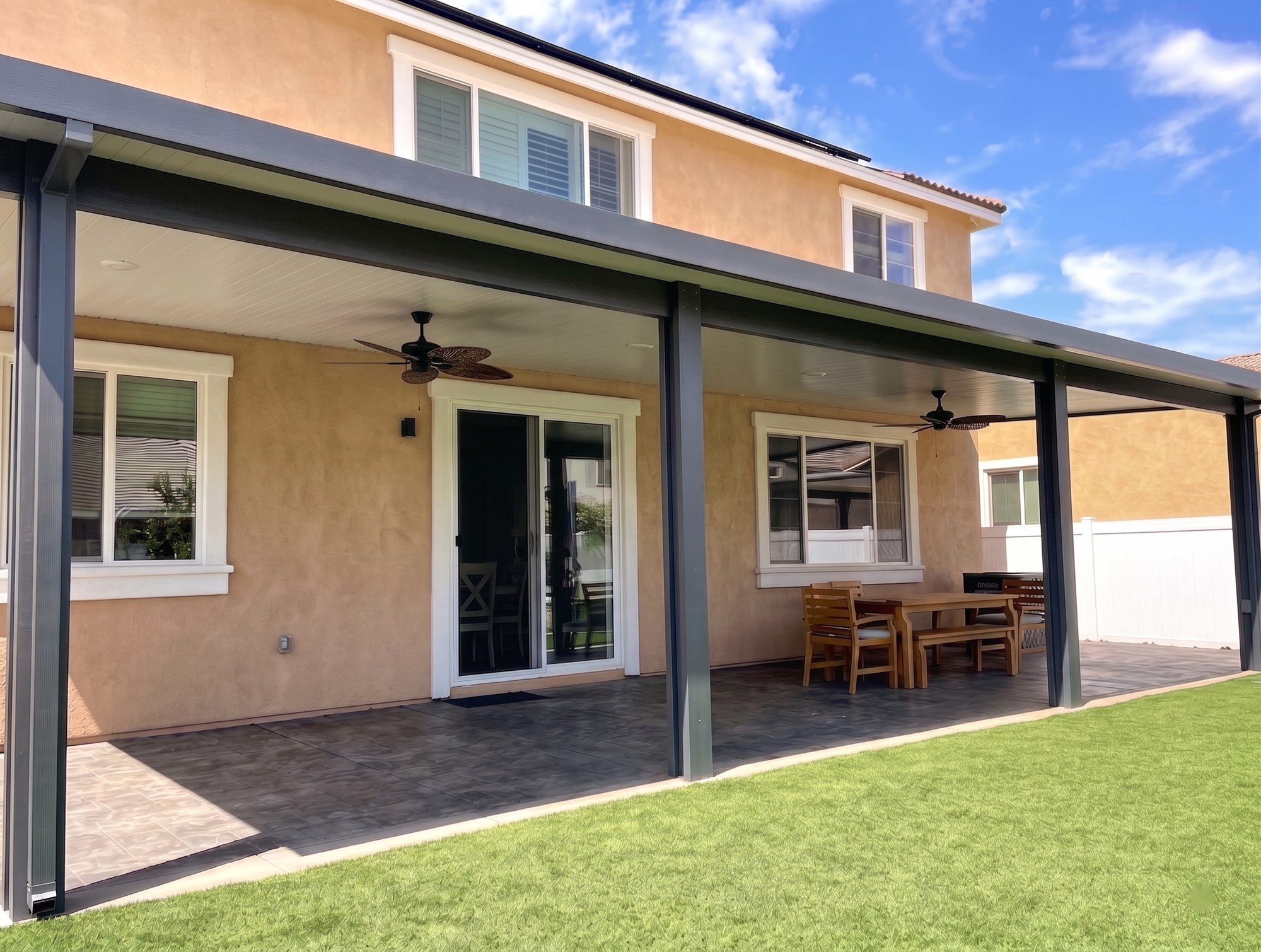
Dark frame and light ceiling on a solid patio cover against tan stucco.
Color is one of the most visible choices on a patio cover, and you’ll see it every time you step outside. We’ve installed aluminum patio covers across Western Riverside County since 1992, and color is often where homeowners slow down.
This patio cover finish guide covers our color charts, finish types and pairings for local stucco, brick and stone. It also explains how color affects heat, fading and the feel under your cover.
It ends with finishes worth seeing in person and a consultation checklist. For the full lineup and our end cut styles, see our patio cover colors page.
Why there are three different patio cover color charts
There isn’t just one patio cover color chart. There are three: one for the frame, one for the solid flat pan ceiling and one for the insulated roof panel ceiling. Each lists different colors, so check which part a swatch belongs to first.
Not sure of your cover type yet? Our solid vs. lattice patio cover guide walks through that choice.
The charts in this guide show Elite’s color options, so if you’ve been comparing Alumawood color options online, this is the lineup to start from. We install Alumawood, DuraCool and 4K patio covers, and exact color availability can vary by product line, so confirm the colors for your chosen line at your free in-home consultation.
Frame and lattice colors
The frame is the posts and beams, plus the lattice tubes on a lattice cover. It has the widest range: ten colors. Gray and Black are available only on the frame chart. On a lattice cover, it’s the only chart you need.
| Frame & Lattice Patio Colors | |
|---|---|
| What it colors | Posts, beams and lattice tubes (the entire cover on a lattice design) |
| Colors (10) | White, Latte, Cameo, Almond, Adobe, Champagne, Mojave Tan, Spanish Brown, Gray, Black |
| Only on this chart | Gray, Black |

Frame and lattice color chart
Solid cover ceiling colors (flat pan)
A solid patio cover uses a flat pan ceiling: formed aluminum pans set side by side to block sun and rain. Its chart has eight colors. The three pan sizes change how the ceiling looks from below.
White, Latte, Cameo and Almond come in every pan size. Adobe, Champagne, Mojave Tan and Spanish Brown come only in the 2 1/4″ x 6″ pan. If you want one of those four, tell us early.
| Solid Ceiling Colors (Flat Pan Ceiling Systems) | |
|---|---|
| What it colors | The ceiling of a solid (non-insulated) flat pan cover |
| Pan sizes | 2 1/4″ x 6″, 3″ x 6″, 3″ x 12″ |
| Colors in all three pan sizes | White, Latte, Cameo, Almond |
| Colors in 2 1/4″ x 6″ only | Adobe, Champagne, Mojave Tan, Spanish Brown |

Solid flat pan ceiling color chart
Insulated ceiling colors (IRP)
An insulated roof panel, or IRP, has foam insulation between two aluminum skins. The ceiling you see is one face of that panel. The insulated roof panels come in 3″, 4″ and 6″ thicknesses, as the chart shows.
The IRP chart has eight ceiling colors, including Krypstone White. Three are woodgrain-look finishes the flat pan chart doesn’t offer: Ponderosa Pine, Cherry Cedar and Countryside Gray. Adobe, Champagne, Mojave Tan and Spanish Brown aren’t on this chart.
| IRP Ceiling Colors (Insulated Roof Panels) | |
|---|---|
| What it colors | The ceiling of an insulated roof panel cover |
| Panel thicknesses | 3″, 4″, 6″ |
| Solid colors | White, Latte, Cameo, Almond, Krypstone White |
| Woodgrain-look colors | Ponderosa Pine, Cherry Cedar, Countryside Gray |
| Only on this chart | Krypstone White, Ponderosa Pine, Cherry Cedar, Countryside Gray |

Insulated roof panel ceiling color chart
Solid and insulated ceilings are different products
Solid and insulated covers aren’t the same roof with insulation added. A flat pan ceiling is one layer of formed aluminum. An insulated roof panel is thicker and layered to slow heat moving through the roof.
The two ceiling charts share only White, Latte, Cameo and Almond. Choose between a solid and an insulated roof before deciding on a ceiling color. Matching an existing cover? Tell us, since its color may be on only one chart.
For a matching frame and ceiling, White, Latte, Cameo and Almond work on any cover, since they’re on all three charts.
Adobe, Champagne, Mojave Tan and Spanish Brown can match throughout a lattice cover or a solid cover with the 2 1/4″ x 6″ pan, but not with the larger pans or an insulated ceiling.
On a solid or insulated cover, a two-tone design, like a Spanish Brown frame with an Almond ceiling, is the only way to get a Gray or Black frame or a woodgrain-look ceiling.
A combination cover mixes solid and lattice. Its solid section uses the solid ceiling chart, and its lattice section uses the frame chart.
Finish types: how the surface looks and feels
The finish is the texture on the aluminum. It decides whether your cover reads as painted wood or smooth modern metal.
Embossed woodgrain finishes
An embossed woodgrain finish has a woodgrain texture pressed into the aluminum, so it looks and feels like painted wood up close. Our Duracool patio covers feature richly embossed HD woodgrain finishes, and our Alumawood covers also carry a wood-look texture.
The texture softens the cover and suits the traditional and Mediterranean-style homes common in Western Riverside County. On a very modern home, it can feel out of place.
For wood overhead, the woodgrain-look insulated ceilings read like stained planks: Ponderosa Pine (golden), Cherry Cedar (rich reddish) and Countryside Gray (weathered gray). They’re only on the insulated chart, which is a good reason to consider an insulated cover.
Smooth modern finishes
We also install 4K aluminum patio covers, a premium system with a smooth finish and no traditional woodgrain. Designed for a modern, high-end outdoor space, it looks clean and architectural.
It suits contemporary homes, dark window frames and minimalist landscaping but can look stark on a very traditional exterior.
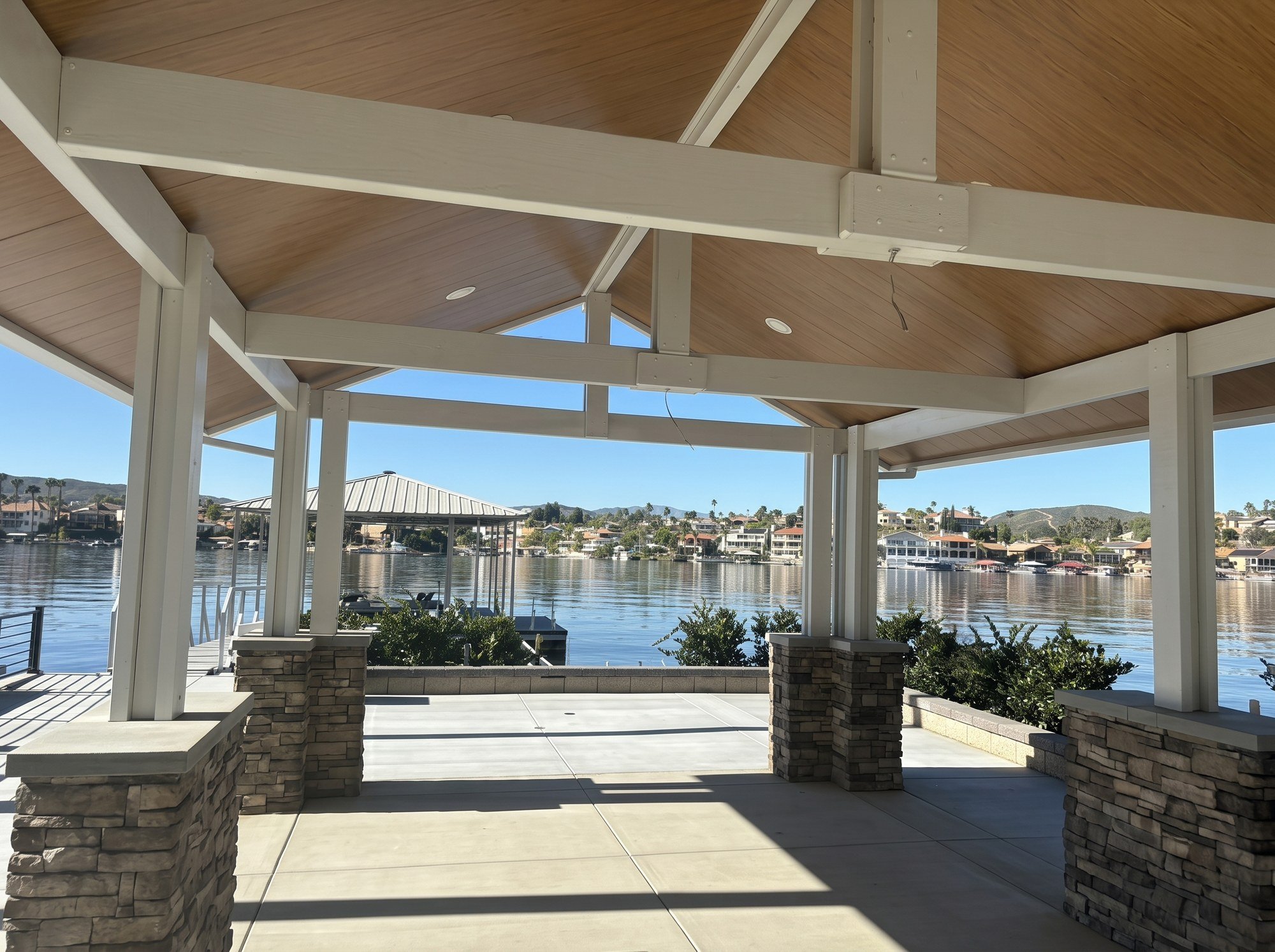
Wood-tone ceiling under a white gable-style frame with stone column bases
Pairing patio cover colors with Riverside County exteriors
Finding the best patio cover color for Riverside County homes starts with the wall the cover attaches to. In Temecula, Murrieta, Menifee, Corona and nearby, that’s usually stucco, often with brick or stone accents.
A frame that matches your trim or fascia looks built with the home. A ceiling that echoes your roof tile ties an attached cover into the roofline. If your trim color isn’t on our charts, a complementary neutral looks better than a near-match.
Have an HOA? Check its approved color list first, since its rules come before any advice below.
Tan, beige and cream stucco
Almond, Cameo and Latte share the warm family of tan, beige and cream stucco. A frame a shade lighter or darker than the wall looks intentional, not like a near-miss.
White works if your trim is white, but it can stand out against a deep tan wall. Mojave Tan and Adobe can suit stucco with gray or green undertones. Judge warm colors in both morning and afternoon light.
White, gray and modern stucco
White or light gray stucco with dark window frames calls for a crisper palette. A White frame and ceiling looks clean and bright. A Gray or Black frame echoes dark windows and gutters for a modern look, with a White or Countryside Gray insulated ceiling.
If a white home has warm accents, like a clay tile roof or wood doors, Cameo or Almond bridges the gap better than stark white. Matching window frames, gutters and the garage door looks more deliberate than matching the wall.
Brick
Red and brown brick has strong color, so the cover should pick up its warmth or step back. Spanish Brown and Latte echo its darker tones. Almond and Cameo give a soft contrast that keeps the brick as the focal point.
White looks sharp next to red brick with white windows and trim. Gray can clash with very orange or red brick. If brick is only an accent, such as on the lower part of a wall or a column, match the main wall instead.
Stone and stone veneer
Stacked stone and stone veneer mix several tones, which gives you more room. Pull the frame color from a shade in the stone, such as Spanish Brown for darker stone.
Lighter gray and cream stone pairs well with Cameo, Almond, Champagne or a Countryside Gray insulated ceiling. With busy, multicolored stone, a mid-tone neutral is safer than a very dark or bright frame. Compare colors right against the stone, since it looks different up close.
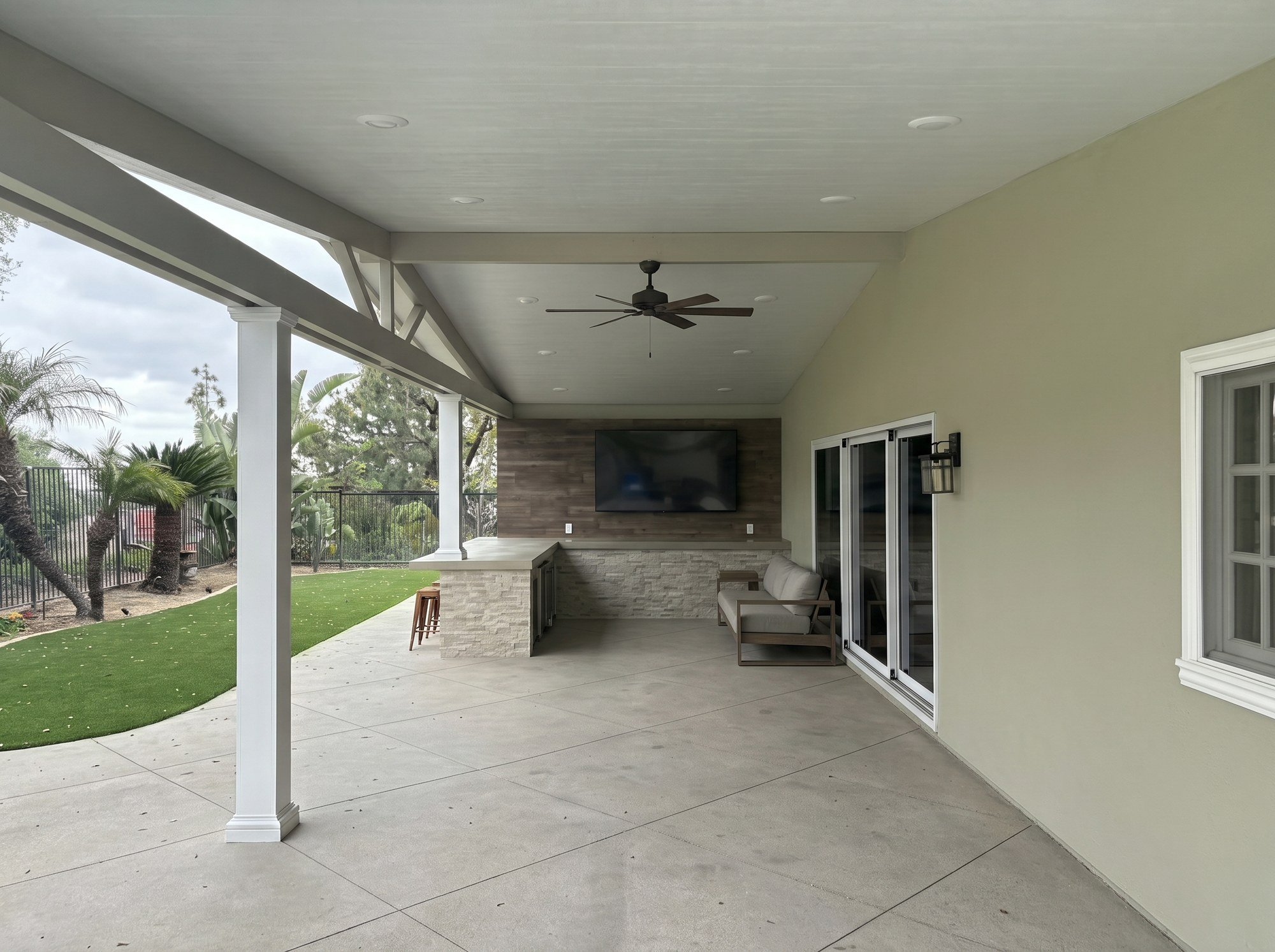
White cover beside a stacked-stone wall and light stucco
How color affects heat, fading and the feel under your cover
Light colors reflect sunlight, while dark colors absorb it as heat. Cool-roof research from Lawrence Berkeley National Laboratory shows the gap: on a summer afternoon, a clean white roof can stay tens of degrees cooler than a darker gray one.
On a patio cover, the roof’s top color matters more for heat than the ceiling color below. Posts and beams take sun on their sides, so a dark frame, especially Black, can get warm to the touch in a hot west-facing spot.
Color isn’t the whole story. Our DuraCool patio covers use cool pigmentation that reflects UV rays skyward to keep the space underneath cooler. The paint system is an approved Energy Star product that references Cool Roof Rating Council guidelines.
That independent group rates how well roofing products reflect and release the sun’s heat. Cool pigments reflect more of the sun’s invisible infrared energy, roughly half of sunlight. So a mid-tone can absorb less heat than the same color in conventional paint.
An insulated cover also slows heat through the roof. No single temperature figure fits each color, since it depends on orientation and shade. Weigh the look against your patio’s afternoon sun.
Fading and the paint system behind the color
UV light slowly breaks down the pigments in any painted surface, and inland Riverside County has long, sunny summers. Fading shows more on deep, saturated colors than on whites and light neutrals.
The exclusive DuraCool paint system includes a DuPont Teflon surface protector for resistance to scratches, abrasion, dirt and stains. Its cool pigments are designed to resist chalking (the powdery residue sun leaves on worn paint), fading and weathering.
Coverage differs by product, so ask which paint system and warranty apply to your line and colors. The lifetime guarantee on our DuraCool page covers DuraCool products only. An occasional hose rinse keeps dust from dulling any finish.
How color changes the feel under the cover
The ceiling color has a major effect on how the space feels. Light ceilings such as White, Cameo and Almond bounce daylight down, keeping the patio and the rooms behind your slider brighter.
Darker and woodgrain-look ceilings feel cozier, which suits an evening space with fans and lights. Our insulated covers are built to support ceiling fans and light fixtures.
The effect is strongest under a solid or insulated roof and smaller under lattice, where sun passes through either way. If your family room already feels dark, lean toward a light ceiling.
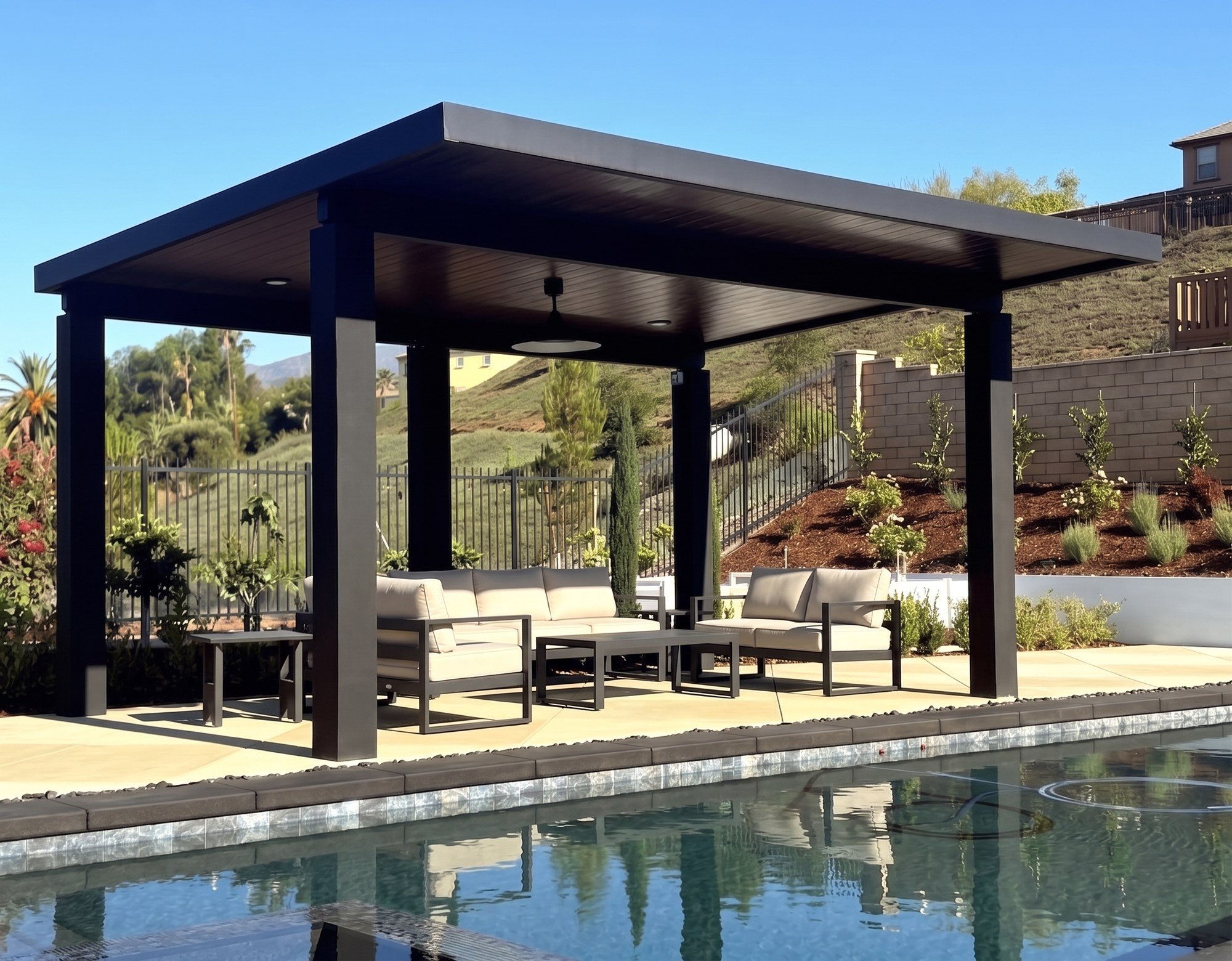
Dark frame and roof on a freestanding cover in full sun
Finishes worth seeing in person
We suggest asking to see these finishes as samples. Colors can look different on a screen or printed chart, so view samples against the wall where the cover will attach. Hold ceiling samples overhead, and hold frame and ceiling samples together for a two-tone cover.
- White or Cameo, top to bottom: Both are on every chart, so they match on any cover and keep the patio brightest. White is crisp; Cameo is softer and warmer and can look more natural against beige stucco or warm trim.
- Almond or Latte for warm stucco: Light, creamy Almond and deeper coffee-and-cream Latte match on any cover type and pan size. On a sun-baked west-facing patio, consider Almond or a Latte frame with a lighter roof.
- Spanish Brown frame with a lighter ceiling: It gives a wood-beam look for brick, stone, dark brown trim or wood doors, and an Almond or Cameo ceiling keeps it bright. Brown looks much darker in shade than in sun, so judge it in your patio’s light.
- A woodgrain-look insulated ceiling: Building an insulated cover? See Ponderosa Pine, Cherry Cedar and Countryside Gray overhead before defaulting to a solid color, since that’s how you’ll see them every day.
- Gray or Black frame for a modern look: On white or light gray stucco, compare both against your window frames and gutters. Gray is more comfortable where posts sit in hot afternoon sun.
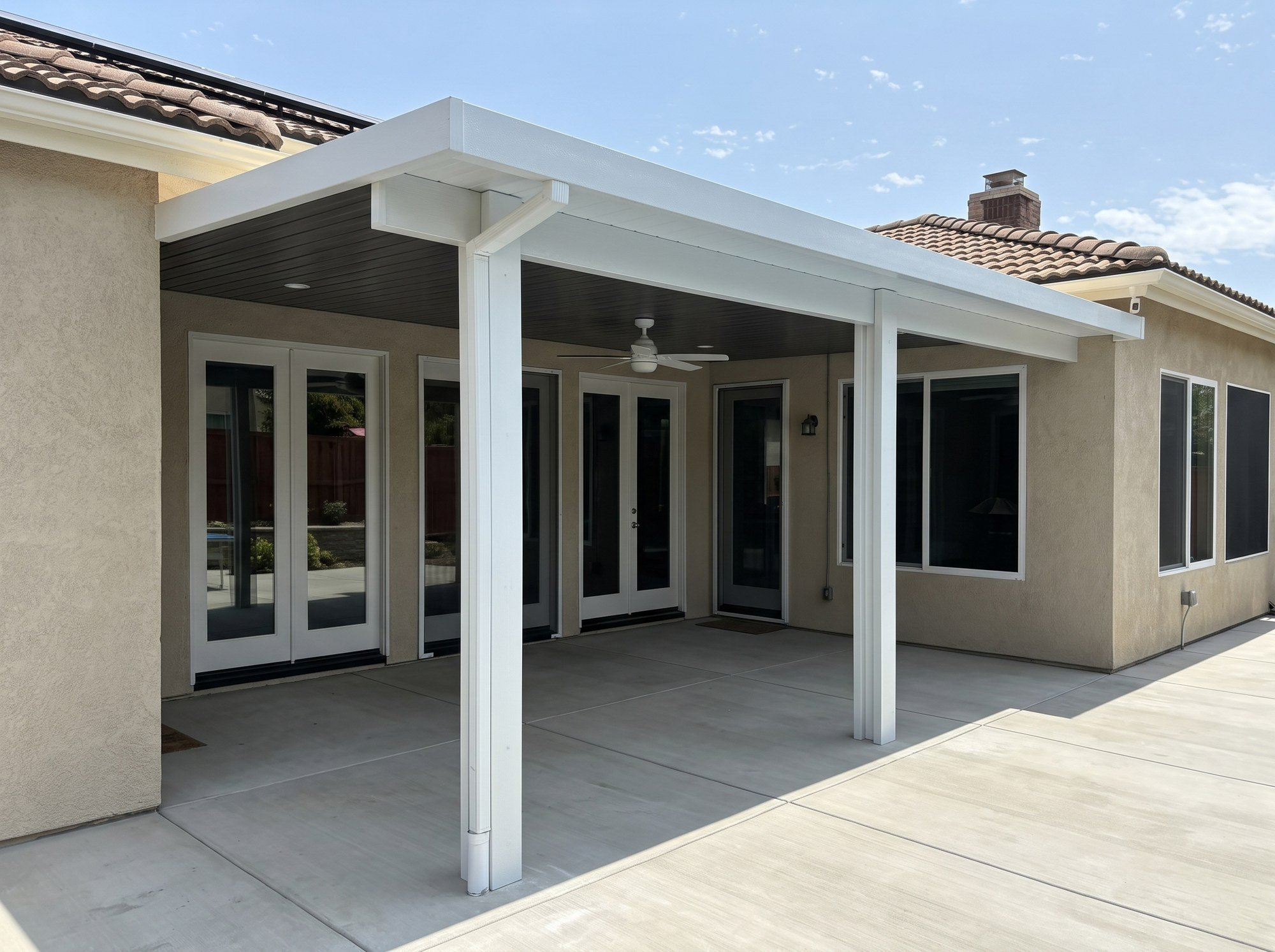
White patio cover against beige stucco and a tile roof
Your color checklist before the consultation
Run through these questions before your consultation to narrow down your colors fast.
- Are you building a solid, lattice or insulated roof cover?
- Do you want the frame and ceiling to match, or a two-tone look?
- What color are your trim, fascia and roof tile?
- Does your HOA have an approved color list?
- Which way does the patio face, and how much afternoon sun does it get?
- Is there an existing cover you need to match?
See the full color and finish lineup in person
Charts and photos are a good start, but patio cover colors are best judged in your own yard and light. At a free in-home consultation, we’ll walk you through frame and ceiling options for your cover type.
We’ll help match them to your exterior and talk through heat, light and HOA rules before you commit. Ask to see samples during your consultation, and we’ll confirm which colors are available for the product line you choose.
See the full color and finish lineup in person; schedule an in-home patio cover consultation.
Prefer to talk it through? Call Elite Patios at (951) 837-6180.
Frequently Asked Questions
What colors do Elite Patios covers come in?
It depends on the part of the cover. Our frame and lattice chart has ten colors, the solid flat pan ceiling has eight and the insulated roof panel ceiling has eight. White, Latte, Cameo and Almond are on all three.
Are solid and insulated patio cover ceilings available in the same colors?
No. They’re different products with different color charts. Both offer White, Latte, Cameo and Almond. Adobe, Champagne, Mojave Tan and Spanish Brown are flat pan only, and Krypstone White, Ponderosa Pine, Cherry Cedar and Countryside Gray are insulated only.
Can my frame and ceiling be different colors?
Yes. On a solid or insulated cover, two-tone is the only way to get a Gray or Black frame or a woodgrain-look ceiling, since those colors appear on just one chart.
Does a darker patio cover make the patio hotter?
Darker roof colors absorb more sunlight than lighter ones, so a lighter roof generally stays cooler. Insulation and cool-pigment paint also play a role, so ask us how each option compares for your patio’s sun exposure.
Will my patio cover color fade?
Every painted surface slowly weathers. The DuraCool paint system is designed to resist chalking and fading, and an occasional rinse helps any finish keep its look.